Homa Delvaray | "Charteegh": Dastan:Outside
Forthcoming exhibition
Overview
Press release
Dastan presents “Chārteegh”, a Focus Room installation by Homa Delvaray as a part of Dastan: Outside program at the Corner of Raaz. “Chārteegh” opens on January 2 ,2026 and will be on view through January 23.
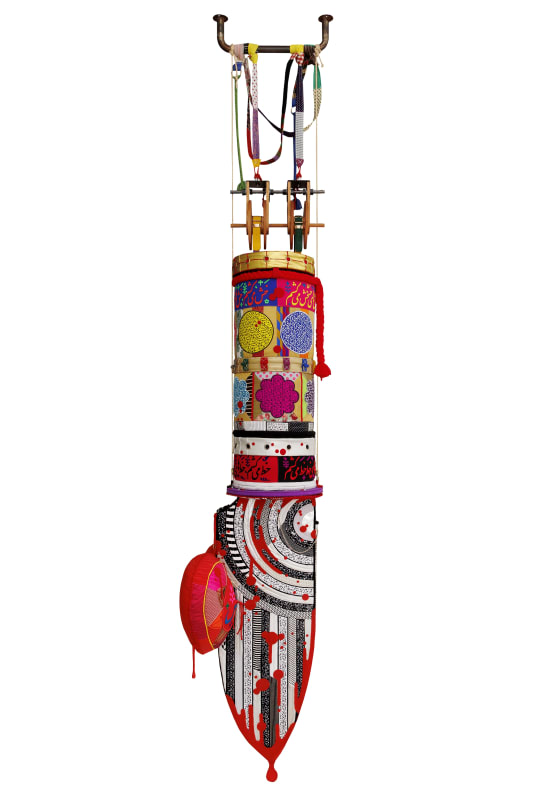
In Chārteegh, Homa Delvaray presents a set of four ‘Tools’ from her “Khâsh” series. These are a group of four suspended sculptural cutting tools (Knife, Sword, Pickaxe, Axe) all presented as commentaries on how superstition is confronted, reproduced, and weaponized. It continues on the artist’s earlier work, “Khâsh Talisman” (2021) which was based on a research on “Fence Talisman” ritual. The ritual describes creating an enclosure drawn with sharp tools during childbirth to ward off the malevolent spirit Āl. Delvaray’s work comments on how the boundaries of superstition and the once-scholary occult sciences merge. In the series, the focus shifts from superstition itself to society’s violent and gendered responses to it. Superstition is historically framed as feminine within patriarchal religious cultures, with women blamed rather than the structures that sustain such beliefs.
In the series, Homa Delvaray turns the familiar forms of weapons and tools into imagined instruments for thought rather than action as nothing in these is truly functioning or serves any functional role. A steel armature is wrapped in layers of fabric, leather, felt, and wool, worn in silkscreen and digital prints, embroidery, patchwork, and even mechanical fasteners. Instead of sharp blades we encounter padded edges, heart-shaped end points and soft, ornamental details. These are weapons that have been deliberately disarmed. The futility of these sculptures is meant to remind us of those superstitious practices that were meant and produced to protect which ultimately became weapons of harm.
Delvaray’s background in graphic design is central to the construction of these works. The surfaces read almost like three-dimensional posters: geometry, floral motifs and bands of colour are carefully composed, and Persian script flows along the shaft and blade. The artist replaces the usual technical inscriptions of a tool with language that describes acts of mark-making, scratching, drawing, tracing lines. Text is not added as a caption; it is woven into the object and becomes part of its body. The tools no longer cut into materials but into meaning.
A recurring motif, visible at the pointed ends of the works, is a red, symbolic heart. It appears where one would expect the hardest impact: the tip of a pickaxe, the cutting edge of an axe-like head. This dislocation is key to the series. Each object stages an encounter between hardness and softness, impact and vulnerability, aggression and care. The long hanging cords and straps that suspend the works emphasize this tension further. They evoke both industrial rigging and domestic weaving or braiding, bringing together worlds that are usually kept apart.
These sculptures sit within Delvaray’s broader interest in Persian visual culture, ritual and language. Earlier projects drew on folk practices and on classical poetry, translating them into dense visual fields. Here, too, the memory of ritual is present, but it has been abstracted into a universal proposition: what if the instruments we use to divide, cut and separate were reimagined as objects that negotiate, protect and communicate? The scale of the pieces, roughly the height of a person, creates an experience almost as counterparts or companions rather than neutral tools.
Shown together, the works function as a small pantheon of fictional devices. Each maintains its own character through variations in colour, pattern and proportion, yet they clearly belong to one family. Their shared vocabulary of hearts, lines, straps and script makes them read like different chapters of the same story. As an ensemble, they suggest not a battlefield but a meeting ground: a place where conflicts are softened, where the sharpest edges are turned into spaces for language, ornament and reflection.
